TEAM SOLUTIONS
 WORKFLOW SOLUTIONS



 REVIEW TOOL
 PROJECT MANAGEMENT
 TOOLS & INTEGRATIONS
 CLIENT INTERVIEWS




Post is also avalible in:


Last updated: August 2026
A little kindness can come back to you when you need it most. Because what goes around comes around. And an error on a final artwork will come back around when you need it the least. A recall is the scariest thing in the artwork & packaging industry to hear. And to avoid such horrors, people came up with the artwork approval process.
So, I’ve compiled a definitive guide of everything you need to know to ensure only your kindness and hard work come back around in the form of a nice fat bonus.
What is artwork approval?
Artwork approval touches every stage of the packaging lifecycle. We’ll discuss it in greater detail later, but contrary to the name, the process doesn’t start at an “approve” or a “review.” It starts the moment someone writes a brief. But it also doesn’t end when someone says “looks good”, because that’s exactly the issue most companies face. A good artwork approval’s last step is a documented, auditable sign-off that proves every check was completed by all the right people.
But what do you need to check? Well, the scope is broad and doesn’t depend on the industry that much: text accuracy, color fidelity, barcode validation, regulatory claims, dieline specifications, translation verification. So, you can be launching a cereal box or a pharmaceutical label, and the artwork approval process will be pretty similar in shape and in keeping expensive mistakes at bay.
Why does artwork approval need to be a “process”?
Listen, how many times have you received one of the following:
- “Sure, I’ll take a quick look”
- “I’ll check in a few minutes”
- “Send it to Janice from legal; she might see something”
- “Hi, it’s Janice from legal. I cannot approve it yet; it hasn’t been through Michael from product. He’s on vacation for two weeks, though”
As you might have already guessed, this is no approval process. The correct process is a system that works for every party involved, while keeping its objective in sight. What I described before is just a chaotic system that, yes, keeps its objective in sight, but turns out to be hell for one specific person who gets the short end of the stick on that project. The best-case scenario is a burnt-out worker, while the worst one is the wrong file in print.
45%
of all US food recalls in 2024 were caused by labeling errors, costing the industry an estimated $1.92 billion in direct expenses.
Source: New Food Magazine, citing FDA enforcement data. link↗
What’s worse, 84% of those were undeclared allergens, aka a single missing line on one label. But food is not the only industry suffering from it. Anywhere a product label exists, the scattered approval must be turned into a working process, because the artwork errors can and will happen. The difference is whether you catch them before production or after.
Here are the industries where a formal artwork approval process isn’t optional:
- Packaging and labeling – where a wrong barcode or missing allergen declaration can trigger a full product recall
- Pharmaceuticals and medical devices – where regulatory bodies require documented proof that every label element was reviewed and approved before production
- Food and beverage – where ingredient lists, nutritional claims, and allergen declarations are legally mandated and regularly audited
- Consumer packaged goods (CPG) – where brand consistency across hundreds of SKUs depends on centralized review and control
- Marketing and advertising – where campaigns go live across print, digital, and retail simultaneously, and one unapproved version can create legal exposure
If your work touches any of these, “just eyeballing it” should stop. And as soon as it does, here’s what an approval process will do for you:
Catch errors before they reach production
Like, the entire point. A structured approval process forces multiple sets of eyes on the artwork at defined stages, with specific checklists for what needs to be verified at each one. Typos, wrong colors, outdated regulatory text all get caught in review instead of on a store shelf.
Keep brand identity consistent across assets

When your cereal box says one thing, your shelf talker says another, and your digital ad uses last quarter’s color palette, your brand looks like three different companies sharing a logo. An approval process with brand compliance checks at every stage prevents this. Every asset gets measured against the same guidelines across all departments.
Ensure regulatory and legal compliance
It’s a non-negotiable in pharma, food, and cosmetics. Regulatory teams need to verify that every claim, ingredient list, and warning text meets current legal requirements for every market the product ships to. A structured process gives them a defined review stage with documentation that proves they signed off.
Create an audit trail for every decision
When something goes wrong (eventually, something always does), you need to know who reviewed what, when they approved it, and which version they were looking at. People make mistakes, and that’s a-okay, but as a company it’s important to understand where and why something went wrong, and plan how to fix it.

Cut revision cycles and speed up time to market
This sounds counterintuitive. More process means slower, right? Wrong! When everyone knows their role, when feedback is collected in one place instead of five, and version control works as it should, you eliminate the three biggest time-wasters: chasing approvals, resolving conflicting feedback, and re-reviewing work that was already signed off two rounds ago. Hence, you work quicker and with fewer cycles.
What are the 5 stages of artwork approval workflow?
Every artwork approval workflow follows the same fundamental sequence. The thing every company decides is how the stages are going to be executed. Depending on team or project size, specificity, stakeholders, market, and deadline pressure, there are two main ways to have the artwork approval workflow:
Sequentially: a new approval stage starts right after the previous one finishes
In parallel: a few similar approval stages are happening at the same time
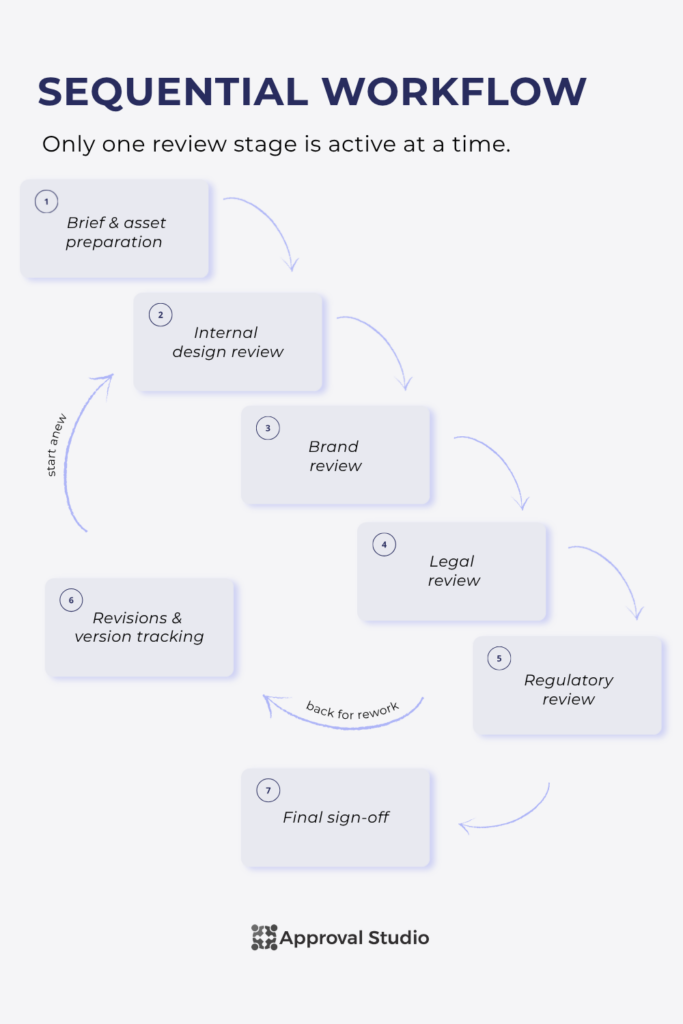
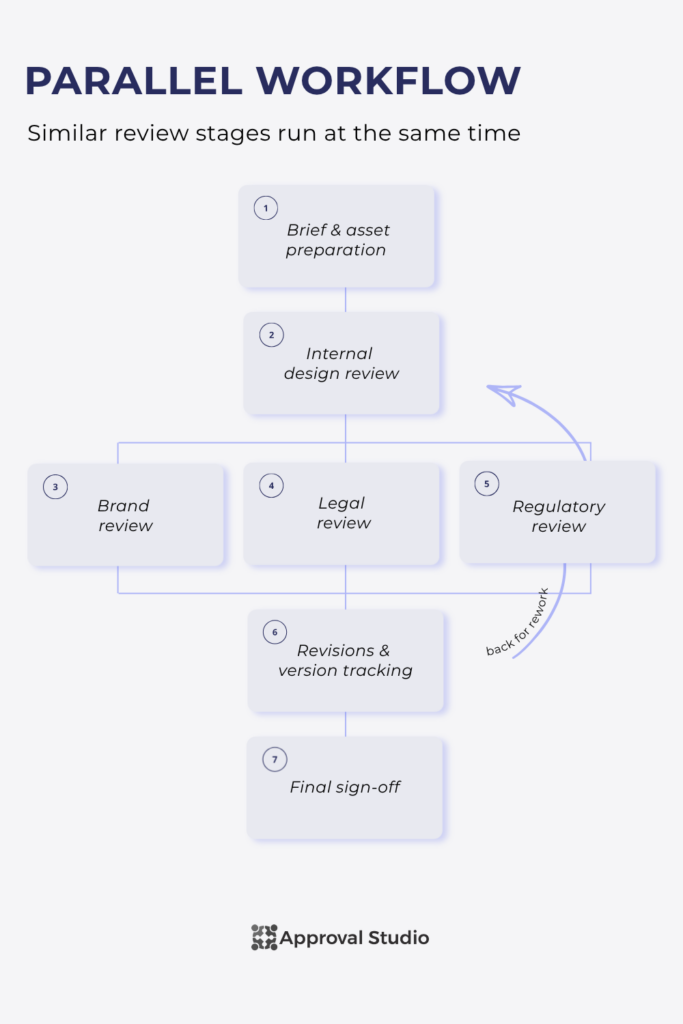
But regardless of how you arrange them, every stage needs to happen. Skip one, and you’ll feel it later.
Brief and asset preparation
Before anyone reviews anything, someone needs to define what “correct” looks like. This means a clear creative brief that includes brand guidelines, regulatory requirements, reference copy and source content, technical specifications (dieline, bleed, color profile), and any region-specific variations.
Omit something in this step, and you end up with three extra rounds of revisions that could have been avoided with a 20-minute brief. The artwork approval process starts long before the first design draft.
Internal design review
The designer or creative team completes the first draft, and it goes through internal review. At this point, we’re not really deciding if we “like” the design. Mostly, it’s a structured check: does the layout match the brief? Are the brand elements correct? Is the copy placed accurately? Are the technical specifications met?
This is where good packaging design software starts paying for itself. It’s much easier to catch layout and specification issues early, before external stakeholders ever see the artwork.

Stakeholder feedback and markup
Now the artwork goes wider. Depending on your industry, this can involve brand managers, marketing leads, regulatory affairs, legal, product managers, and external clients. This is the part where your workflow can either go in parallel or sequentially. Each stakeholder reviews against their specific criteria: regulatory checks the claims, legal checks the disclaimers, brand checks the visual identity.
The critical rule: all feedback goes in one convenient place. Sure, you can hire (or overwork) someone to gather all email, Slack, and handwritten notes in a Google document to get that centralized location feel. Still, it is better to have a centralized platform that automatically does that for you and, in addition, reduces confusion because every comment is pinned to the exact spot on the artwork it refers to.
This is, without exaggeration, the single change that saves the most time. Scattered feedback is the number one killer of efficient artwork approval.
Revisions and version tracking
The designer implements the feedback, creates a new version, and the review cycle continues, sometimes even while the designer is working. For a lot of processes, this is the most confusing part. We’ve all been through Version 3, version 3_final, version 3_final_FINAL, version _actually_final_PLEASE_USE_THIS_ONE –
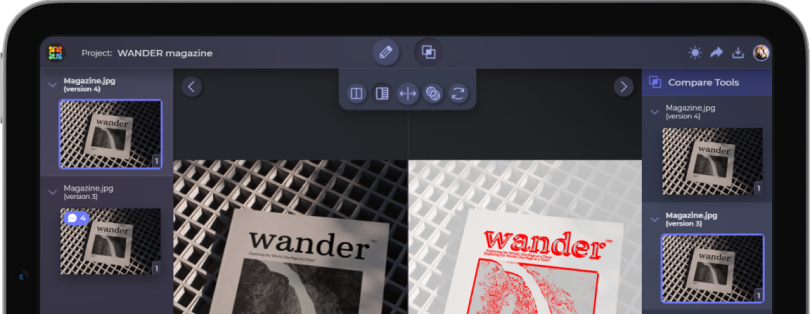
A proper artwork approval workflow tracks every version automatically, lets reviewers compare what changed between iterations, and makes it crystal clear which version is current.

Final sign-off and production hand-off
The last review round ends with a formal sign-off, sometimes even an electronic signature from every required stakeholder, rather than a casual “yep looks good” over Slack. This sign-off is what authorizes the artwork to go to print or production.
The hand-off matters too. The production team or print vendor needs the correct file format, the right color profile, and documented proof that the artwork passed every review stage. In regulated industries, this documentation isn’t optional. It’s literally what you show auditors.
How to build a successful artwork approval process
We like to think that things fall apart with a big bang. A single critical thing that couldn’t be ignored. However, usually it’s an amalgamation of a dozen small things ignored for ages. The good news is that every one of these is easily fixable if you know how.
How to choose the right artwork approval software
Choosing a tool is less about how big feature lists are and more about whether the software fits the way your team needs to work. Before you start evaluating options, answer these questions:

What’s your compliance situation? If you’re in pharma, food, or cosmetics, you need a tool that provides a documented audit trail, role-based permissions, and locked approvals that can’t be undone without a record. If you’re a marketing agency reviewing campaign creatives, your compliance can be lighter.
How complex is your review workflow? A two-person design team reviewing social posts doesn’t need the same infrastructure as a CPG company managing 500 SKUs across 12 markets with regulatory review in every one of them. Match the tool to your workflow complexity and team size.
Who needs access and how much? Count your stakeholders. Internal teams, external clients, regulatory consultants, print vendors. Some tools charge per reviewer. Others let external participants join without an account. When your review cycle involves 10+ people, this distinction makes a difference in cost.
What do you actually work with? Packaging artwork, PDFs, video, web designs, Office documents, etc. Make sure that the tools you are considering handle all of them. If your team works across formats, narrow your shortlist to platforms that support them natively instead of through workarounds.
Does it fit your existing stack? Your company wasn’t born yesterday. Congratulations if it was, though! There are already project management or design software tools in use. A standalone approval tool that doesn’t connect to any of them is just another silo. And you don’t need another silo. Check for integrations before you commit.
If you want a more in-depth analysis of what you might need, look at our guide to review and approval software features. It covers the feature-by-feature evaluation in excruciating detail.

How to do artwork approval well: a checklist
Have you ever heard of the fear of the blank page? It’s when the writer cannot start writing because of the terrifying white vastness of the yet untouched page. That probably happened to you too, but with a design. Sometimes, it’s easy to annotate, but other times it’s torture. But just like with the writing, all you have to do is start.

So, I’ve compiled a list of basic artwork approval checks to get started. Pin this somewhere visible (or use artwork approval software with checklists built in). Before anyone clicks “approve,” every item on this list should have a check next to it.
Content and copy
- All text matches the approved copy document
- Spelling and grammar verified in every language variant
- Product name, variant, and size are correct
- Ingredient list is accurate and in the required order
- Nutritional information matches the source data
- Allergen declarations are present, complete, and formatted per regulation
- Legal disclaimers and regulatory text are current for every target market
- Contact information and website URLs are correct and active
Brand and design
- Logo is the correct version (color variant, minimum size, clear space)
- Brand colors match the approved palette. Check the actual CMYK or Pantone values
- Fonts are correct, properly embedded, and licensed for the intended use
- Image resolution meets print quality requirements
- Layout matches the approved design template
- Visual language is consistent across all variants and SKUs in the same product range
Technical and production
- Barcode type, size, and placement meet retailer and industry requirements
- Barcode scans correctly at the intended print size (test it)
- Dieline specifications match the physical packaging structure
- Bleed, trim, and safe zones are correctly set
- Color profile is correct for the print process (CMYK, Pantone, extended gamut)
- File format and export settings meet the printer’s specifications
Regulatory and compliance
- All claims (health, environmental, origin, certifications) are substantiated and approved
- Country-specific regulatory requirements are met for each target market
- Warning symbols and safety marks are present where required
- Recycling symbols and material identification codes are correct
- Expiry date format and batch code placement are specified
This covers the essentials. Your specific industry will add its own requirements on top, such as GMP documentation needs for pharmaceutical labels, country-specific allergen formatting rules for food products, and ingredient listing standards for cosmetics. What’s more, your company might have its own specific checks on top of that. Or, some of these checks won’t be as full because the tool you are using has already automated mechanical requirements checks.
How to present the importance of artwork approval to your team
Now, you are a pro at how an artwork approval process should look, and you might even be seeing some issues the team has right now. But you cannot build a process by yourself. Surely, at the most basic level, it doesn’t require much monetary investment, but convincing people to change their ways is always the hardest part. And as a little sweet treat, let me help you with that as well. Here are three things you should remember when presenting your case:
Lead with the money. Do you remember how I mentioned that label errors caused 45% of all US food recalls in 2024? Use it! That’s not a niche problem in a niche industry. The best language corporate speaks is the language of money, and if you show them how a few days of setup can save them from recalls because of a single allergen line, you are the employee of the month!
Then make it personal. Ask your team if they have specific instances when they felt angry, upset, or burnt out because of how the approval went. Make each tell a story, and each listen to this story. Seeing many people relate to the same problem will help increase the desire to change something.
Don’t try to overhaul everything at once. The easiest sell isn’t a presentation. It’s a pilot. Say that you will pick one project, product line, or upcoming campaign. Nothing big, but something everyone is involved in. Then, run it through a structured approval workflow with a proper tool. Usually, the free trial most tools offer is more than enough for that. And then sit back and wait for results, because chances are they won’t want to go back to the old way.

Most resistance to adopting approval tools isn’t really about the tool. It’s just that people don’t like the change, and the perceived effort of learning something new seems like too much. However, once people actually experience a structured workflow for one full cycle, the difference between “before” and “after” is so obvious that the tool sells itself. Just get them through that first run and discover that for themselves.
Final thoughts
Artwork approval is not glamorous work. Nobody’s winning industry awards for “most thorough review checklist.” But it’s the difference between a product that launches cleanly and one that gets pulled from shelves three weeks later because someone missed a line on a label.
The process doesn’t need to be complicated. Define your stages. Assign your reviewers. Centralize your feedback. Document your sign-offs. And stop pretending that email threads and shared folders are a system – they’re a liability.
If you’ve made it this far, you don’t need more convincing. You need to start. Pick one project, run it properly, and let the results make the case for you.