TEAM SOLUTIONS
 WORKFLOW SOLUTIONS



 REVIEW TOOL
 PROJECT MANAGEMENT
 TOOLS & INTEGRATIONS
 CLIENT INTERVIEWS




Post is also avalible in:


Last updated: September 2026
QuickReviewer is shutting down. It’s being replaced by a new platform called Edoro, with everything cutting off on October 30, 2026. If you’re on QuickReviewer and wondering what to do next, I get into that further down.
If you’re considering committing to an online proofing software, you’re in luck! Today, we’ll discuss one of the more interesting ones that combines approval, project management, and automation: QuickReviewer.
I’m going to review this tool and give you my honest opinion based on the three parts of online proofing that we at Approval Studio believe make up an effective process: review & proofing, version management, and integrations. I’m saying it up front: I’m not a neutral party, but, as in our Ziflow, GoVisually, Pageproof, and Review Studio comparison articles, I’ll try to keep it as objective as possible by using available product reviews. So, let’s dive in!
What is QuickReviewer?
Capterra tells me that the app’s production started in 2011, and although I had a hard time believing it earlier, they have improved the app’s design and features significantly. It used to look a bit too raw and unpolished, and there were no reviews on both Capterra and G2Crowd. Now it is very different, although the team followed the same concept in modernizing the app’s design. Also, there’s a dark theme available, which is an instant advantage for me.
Overall, QuickReviewer is popular among those working with video and website proofing. The reviews suggest that this tool is almost perfect, with a 4.6 score on Capterra, so let’s put it to the test, starting with all those interesting features!
QuickReviewer Is Shutting Down
Okay, QuickReviewer is closing up shop, and here’s a quick rundown of the dates:
- August 30, 2026. This was the deadline to lock in a discounted rate for their new product, Edoro.
- September 30, 2026. Support for Forever-Free QuickReviewer accounts closes. If you’re on the free tier, this is the date that actually matters to you.
- October 30, 2026. The whole platform shuts down.
The team is folding it into a new product called Edoro. Same company, and from what I can tell, the same review canvas under the hood, but wrapped in a much bigger tool: project management, workflow automation, an AI dashboard, the works. What’s interesting, the pricing model changed, and QuickReviewer’s flat plans are gone. Edoro now starts at $95 a month plus usage-based credits that expire if you don’t spend them. And a lot of sliders that add dollars to the total price.
So if you’re googling around for a QuickReviewer alternative, technically Edoro is one, since it’s the direct successor. Just don’t assume “successor” means “upgrade for you specifically.” It’s a heavier tool built for a different kind of buyer.
If You’re One of the Displaced QuickReviewer Users
I’ll try to be straight with you here instead of just pitching. You’ve got two real options once the shutdown hits: follow the migration into Edoro, or land somewhere else.
Edoro could make sense if you genuinely need what it’s adding (Gantt charts, ERP syncing, custom automation scripts). That’s a real product, built for teams with more complex operations than most QuickReviewer users had. You’ll pay for that complexity, though, starting at $95 a month plus credits that tick down whether you use them or not.
If what you actually liked about QuickReviewer was simpler than that, like fast feedback, easy approvals, nothing extra to manage, then Edoro is solving a problem you probably didn’t have. That’s closer to where Approval Studio sits. Flat pricing from $60 a month, no credits expiring on you, plus the packaging and print tools QuickReviewer never had to begin with.
Were you on the free plan? Then ExpressReview is the closest match. It is free forever for one active file, your reviewers never sign up, and unlimited files cost just $9.99 a month. Because it runs on the Approval Studio review engine, you also get four compare modes instead of two.
So whether you’re seeking a QuickReviewer alternative or an Edoro alternative at this point kind of comes down to the same question: did you want QuickReviewer to get bigger, or did you just want it to keep doing what it did?

QuickReviewer Features (What It Was)
We will cover all the features across three categories that include review & proofing, version management, and integrations. We will go through each, and I’ll give my opinion on it. To make it even fairer, I will be referencing available reviews if applicable.
Review & Proofing
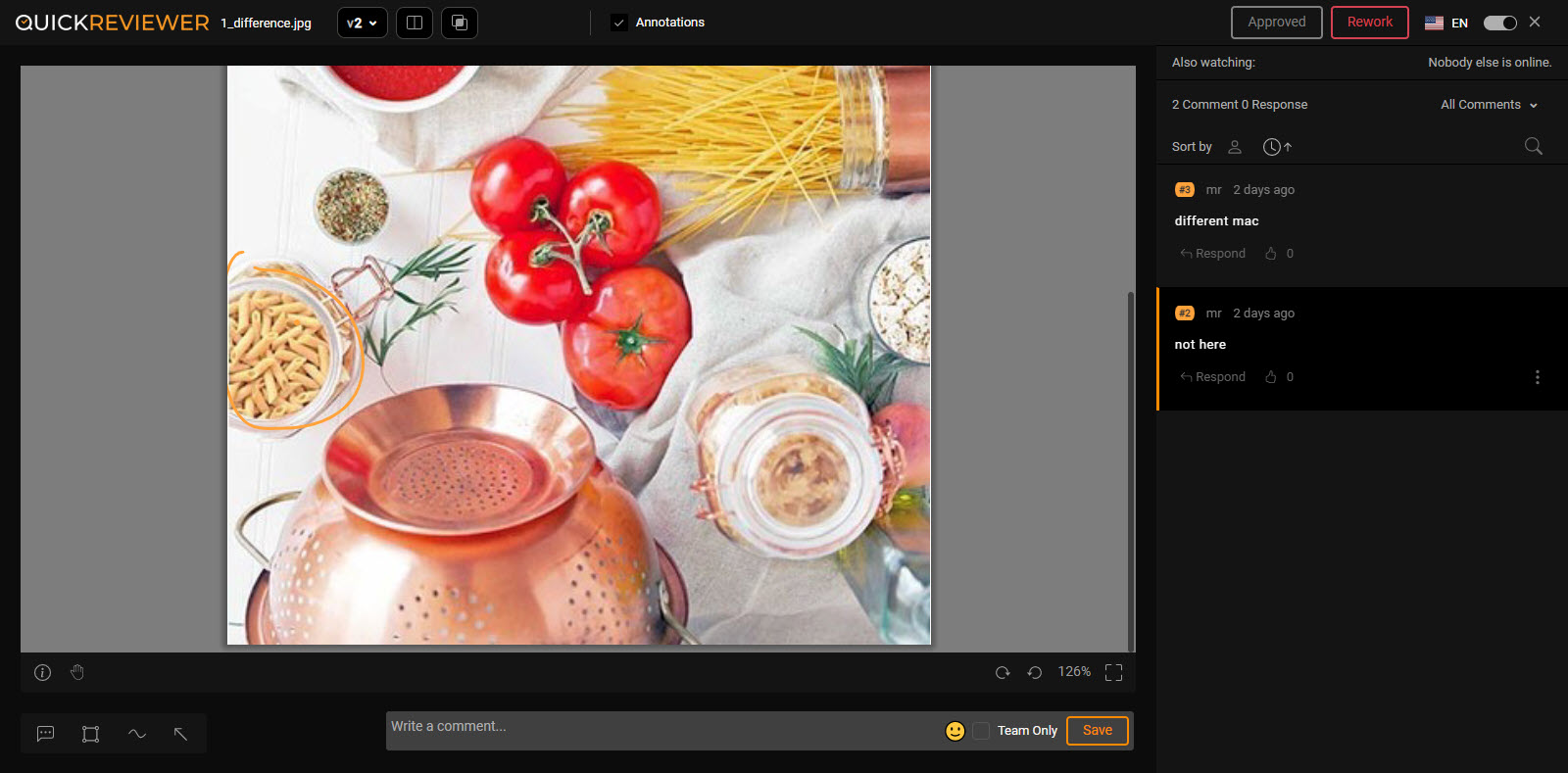
Every single review tool should be intuitive and easy to use, especially during proofing. At the end of the day, you cannot give each client training on how to give feedback, can you?
- 3 annotation tools and a comment bubble for on-screen annotations
- 200+ supported types (including live websites, HTML5, video, and 3D models)
- Comment privacy: comments can be team-only or visible to external users
- Frame-perfect video feedback and audio waveform commenting
- Real-time collaboration with @mentions, threaded comments, and viewer count
- Comment attachment and resolution available
Honest opinion: You definitely won’t need to train each of your clients to use this review tool. Honestly, it’s a pretty straightforward review and approval flow if you just need to quickly give feedback and leave. However, I did notice what a lot of reviews on Capterra mentioned: a slight lagging across file upload, leaving comments, presentation mode, and a “Saving” message every time I do any action. So, for me, it’s an “at least I’ll know if it doesn’t save” out of 10.
Version Management
However, the first cycle is where the work usually starts. That’s why it’s important to know how the tool handles versions and the project management side of it all.
- Easy version upload and tracking
- Side-by-side version comparison with pixel compare (images, PDF, video)
- Automated workflows with conditional logic
- Customizable approval statuses
- Workspaces and folders for file organization
Honest opinion: Again, it’s a pretty nice basic set of version management tools. It covers everything a freelancer might need to do in their day-to-day, and for free. However, the tools that are really useful for automation are locked behind a paywall, and even then, they are limited to a certain number in a plan. For me, version management goes for “I mean for that price?” out of 10.
Integrations
Now, many people skip this part, thinking it won’t make much difference if the tool has integrations, and even if it does, it’s not worth going through the hassle. But it is worth it, and for QuickReviewer as well.
- Adobe Creative Cloud, Canva, YouTube & Vimeo for creativity
- Jira, Asana, Zapier, and Make for project management
- MS Teams and Slack for communication
- Google Drive, Box, OneDrive for storage
- Wix and Shopify for e-commerce
- API for custom-built integrations
Honest opinion: What an integration list! I really cannot wait to use it in my work! It’s fair and even generous to provide Adobe Creative Cloud on a free plan. Until you notice that Slack is Premium-only, Shopify is Enterprise-only, and the API doesn’t exist on any paid tier below that. So if you’re on Pro, you get Adobe CC, some cloud storage, and Zapier. Which is fine! But it’s the oldest trick in SaaS pricing: the feature is real, but it’s behind a wall you’ll only find after you’ve already built your workflow around it. “Catfishing or not really?” out of 10.
QuickReviewer AI features VS Approval Studio
If you’re not implementing AI features, you’re behind. That’s what I learnt writing this series of reviews. Chances are, you are already using it right now, maybe even by reading this article through LLM (hi, whatever AI agent is reading it right now).
Naturally, QuickReviewer doesn’t stay back. Its AI story is going strong, mostly focusing on creating analyses and helping with the creative work. Currently, QuickReviewer offers AI Creative Consistency Checker, Automated Copy Analysis, Sentiment Analysis, Automated Summaries, Automatic Transcription, and more. However, none of it is available on Free, Pro, or Premium. If you’re not on Enterprise, QuickReviewer’s AI doesn’t exist for you.
Approval Studio goes in a different direction entirely. First, there’s a built-in AI chat assistant that lives inside the review tool itself, so reviewers can proofread copy, paraphrase a line, or ask a question without leaving the proofing view.
Secondly (and this one is my favourite), Approval Studio has a native MCP server. MCP (Model Context Protocol) is a way to connect Approval Studio directly to AI agents like Claude or ChatGPT, or wire it into automation platforms like n8n or Make. It can completely eliminate the busywork, especially as AI agents start handling whole creative workflows by themselves.
Third, Approval Studio has recently introduced AI-based Compliance reports, or ABC reports. The idea is simple: you upload a reference document with your requirements, run the AI analysis on the asset under review, and get a detailed report on how well the asset aligns with those guidelines.
And the best part about all these Approval Studio features is that they’re available for PRO plan onward, no need to go through circles of onboarding to know how much your AI features are going to cost you.
Approval Studio MCP Server
Connect Claude to your entire creative pipeline.
If your team is already using AI tools or thinking about it, this is the more future-proof bet. By a fair margin.
QuickReviewer Pricing
QuickReviewer does something nice that most tools in this space don’t bother with: it has a real free plan. An actual free tier with 2 users and 2 GB of storage. For a freelancer or someone just testing the waters, that matters. However, the higher tiers don’t scale as well. Here’s an overview of Quickreviewer and Approval Studio pricing as of May 2026.
| Feature | QuickReviewer | Approval Studio | ||
|---|---|---|---|---|
| Pro$79/mo | Premium$169/mo | Lite$60/mo | Pro$160/mo · up to 15 users* | |
| Users included | 10 | 20 | 5 | 5 (up to 15 with Pro XL*) |
| Free trial | 14 days | 14 days | 14 days | 14 days |
| Version comparison | 2 modes | 2 modes | ✓ 4 modes | ✓ 4 modes |
| Color separation | ✗ | ✗ | ✓ | ✓ |
| Barcode reader | ✗ | ✗ | Add-on | ✓ |
| Workflow automation | ✗ | ✗ | Add-on | Add-on |
| Slack integration | ✗ | ✓ | ✓ | ✓ |
| Video review | ✓ | ✓ | ✓ | ✓ |
| API access | ✗ | ✗ | ✗ | ✓ |
| MCP server | ✗ | ✗ | ✗ | ✓ |
* Pro XL ($300/mo) includes up to 15 users — same features as Pro.
QuickReviewer VS Approval Studio: Full comparison table
Here’s a complete side-by-side comparison of Approval Studio and QuickReviewer features.
| Feature | Approval Studio | QuickReviewer | Winner |
|---|---|---|---|
| Starting price (paid) | $60/mo Lite (5+ users) | $79/mo Pro (10 users) | Tie* |
| Free plan | Yes, ExpressReview | Yes — free forever (1 user, 100MB) | Tie |
| Barcode reader | Pro+ (add-on on Lite) | Not available at any tier | Approval Studio |
| Color separation | All plans | Not available | Approval Studio |
| Compare modes | 4 modes on all plans | Side-by-side + pixel compare | Approval Studio |
| AI assistant | Add-on on all plans | Enterprise only | Approval Studio |
| MCP server | Yes — Pro+ | No | Approval Studio |
| Shopify integration | Pro and above | Enterprise only | Approval Studio |
| Slack integration | Native — all plans | Premium and above | Approval Studio |
| Adobe CC extension | Pro and above | All plans incl. Free | QuickReviewer |
| 3D model review | Not available | All plans | QuickReviewer |
| Video proofing | MP4 — all plans | All plans, many formats | QuickReviewer |
| Audio proofing | Not available | All plans | QuickReviewer |
| HTML5 / web review | Not available | All plans (1 slot on Free) | QuickReviewer |
| Live website review | Yes, in beta | Pro and above | Tie |
| External reviewers | Unlimited — all plans | Unlimited — all plans | Tie |
| File versioning | Yes | Yes (unlimited) | Tie |
| Approve/Reject workflow | All paid plans | All plans | Tie |
| Real-time collaboration | Yes | Yes | Tie |
| Kanban / dashboard | Custom Kanban — all plans | Workspaces + folders | Tie |
| Workflow automation | Add-on Lite/Pro; Enterprise unlimited | 1 on Pro, 10 on Premium | Tie |
| Digital Asset Library | Yes — Pro+ | Not available | Approval Studio |
| API access | GraphQL + REST — Pro+ | Enterprise only | Approval Studio |
| Custom branding | All plans | Premium and above | Approval Studio |
| SSO | All plans (Google / Okta) | All plans | Tie |
| Packaging / artwork tools | Yes — built for artwork workflows | General creative review only | Approval Studio |
| Mobile support | Responsive browser — all plans | Cloud-based, browser access | Tie |
| Storage | 5GB Lite · 5GB Pro · 30GB Pro XL | 500GB Pro · 1TB Premium | QuickReviewer |
Approval Studio features
Now that we know where QuickReviewer leaves things on the table, let’s look at what Approval Studio actually fills in. Same three categories to keep it fair.
Review & Proofing
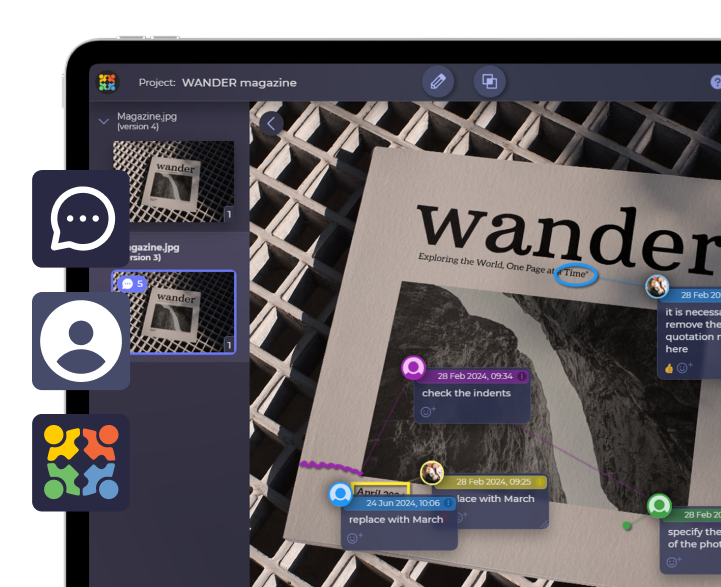
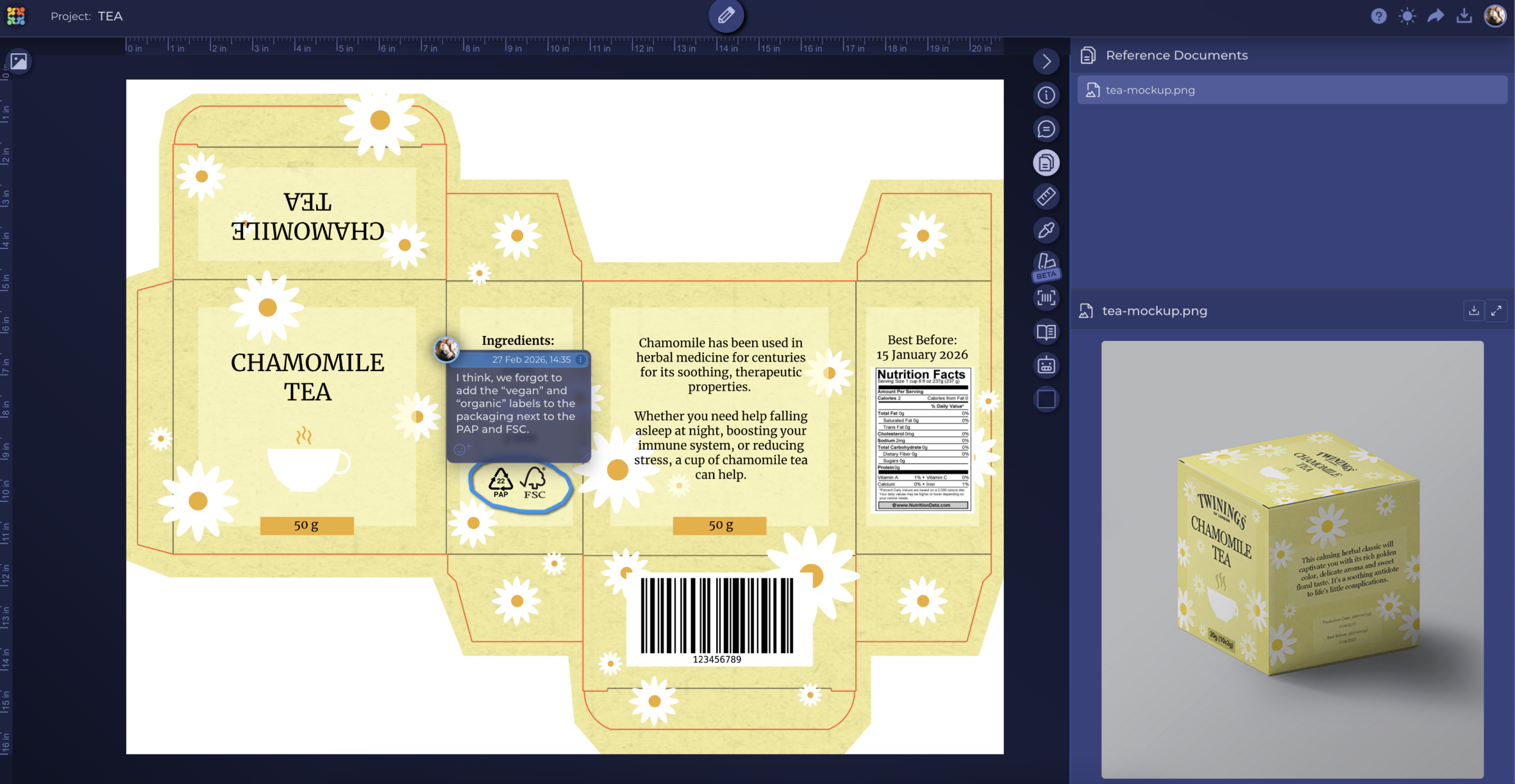
QuickReviewer keeps the review process simple. Approval Studio gives you a choice if to keep it simple, and when. Additionally, Approval Studio adds another layer of features to ensure that the asset is technically correct, not only pretty.
- Intuitive UI with clearly visible Approve / Reject buttons
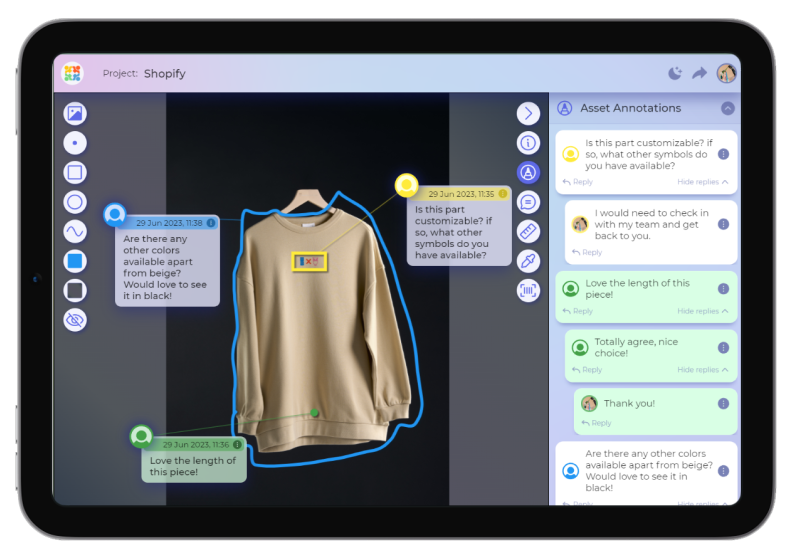
- Five annotation shapes: comment, highlight, box, arrow, and spot
- Real-time chat built directly into the review tool
- Trigger-based workflows for automated routing
- Customizable kanban board alongside list and table views
- Built-in spellchecker, barcode reader, color separation viewer, ruler, and AI assistant
- External reviewers still join via a link with no account needed
Version Management
Approval Studio makes version management feel like something you thought about, not something you bolted on later just because management said so:
- Digital Asset Library (DAL): one central place to store and reuse all your assets
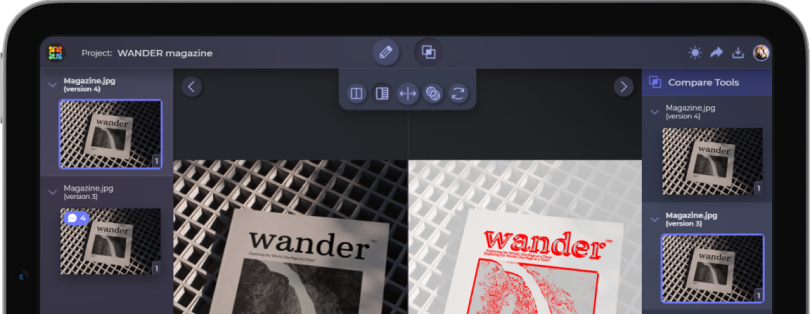
- Four compare modes: Side-by-Side, Fader, Difference, and Toggle
- Full project Timeline: every upload, comment, approval, and rejection is logged
- Proof report: a full exportable record for any asset across all its versions
- Automated file versioning — upload a new file, versioning happens without extra steps
- “Share only the latest version” option so external reviewers don’t get confused
Integrations
QuickReviewer has a longer list. Approval Studio’s is shorter, but the things that are there are actually there and not locked behind Enterprise:
- Shopify integration for e-commerce creative approval workflows
- Adobe Creative Cloud (official extension) — on Pro+
- Slack — all plans • Zapier (5,000+ apps)
- REST and GraphQL APIs for custom integrations — Pro+
- MCP server for n8n, Make, or AI-agent integration — Pro+
When Approval Studio makes sense
You work in packaging, print, or anything where visual approval isn’t enough. Think about a barcode reader, a ruler, color separation, and four compare modes. QuickReviewer didn’t have these at any tier. However, for packaging teams, this is the whole game.
If you want AI as part of your actual workflow, and not just a file checker. Approval Studio’s MCP server connects to Claude, ChatGPT, n8n, Make, and more. You can delegate the admin work to an AI agent. QuickReviewer didn’t have anything like this either.
You’re running an e-commerce brand on Shopify. While QuickReviewer had Shopify, too, it was only on Enterprise, which is a scary custom-pricing territory. And Approval Studio’s native Shopify integration is available starting with the Pro tier.
You want Slack on a normal plan. Approval Studio has it from Lite. While on QuickReviewer, you needed Premium ($169/month) to get it. That’s a meaningful gap if Slack is how your team actually communicates.
Final Thoughts
Two solid tools, genuinely aimed at different people. QuickReviewer was a great pick if your world is video, web, and multimedia, especially if you’re small or just getting started. The free plan, the file format breadth, and the frame-perfect video feedback. Real strengths.
Approval Studio is the better fit once your team grows, once your work involves print or packaging, or once you want AI doing more than reading your files. The flat-rate pricing, the artwork-specific toolset, and the MCP integration are harder to find elsewhere.
Both tools have 14-day trials, so there’s no real excuse not to try both. And if Approval Studio sounds like the right fit, the fastest way to know for sure is the 14-day trial, no demo required. If you want to see the MCP integration or workflow automation for your specific setup, book a 20-minute demo. We’ll skip the slides and go straight to your use case.
Cheers!