TEAM SOLUTIONS
 WORKFLOW SOLUTIONS



 REVIEW TOOL
 PROJECT MANAGEMENT
 TOOLS & INTEGRATIONS
 CLIENT INTERVIEWS




Post is also avalible in:


Design today is rarely about being a lone wolf and doing cool things in the dark corner of your room. After the pandemic ended, people needed to come back to human connection, and work was not an exception. The trend started to shift towards collaboration, teamwork, and building culture, both in corporate and smaller businesses. However, what you might see is that despite the burning longing for human connection, teams all around the world are having issues staying together and actually being a team. Why does it happen?
Let’s talk about design team collaboration, its failures, and what we can do to be better teammates.
Why team collaboration matters
What is even team collaboration? It’s a process of a group of individuals with complementary skills working together to achieve a common goal. Ideally, it works in such a way that each of those individuals has a say (some bigger, some smaller) and has a clear understanding of an end goal and how it’s going to benefit them specifically.
In design, this matters even more because so much of the work is subjective. You’re not only creating something; you’re aligning with people, with processes, with opinions, and with the overall direction of a brand or product. Strong collaboration allows everyone to see the bigger picture and brings order to the natural chaos of creative work. And when it works as intended, you get a nice landing page or a polished visual identity and a team that actually enjoys building things together. And that’s the real win.
But when it fails, that’s where the real problems begin.
Why does it fail?
Team collaboration failures come down to three main reasons: improper communication, goal misalignment, and lack of trust. Let’s discuss each of these in detail.
Make sure team collaboration works as designed

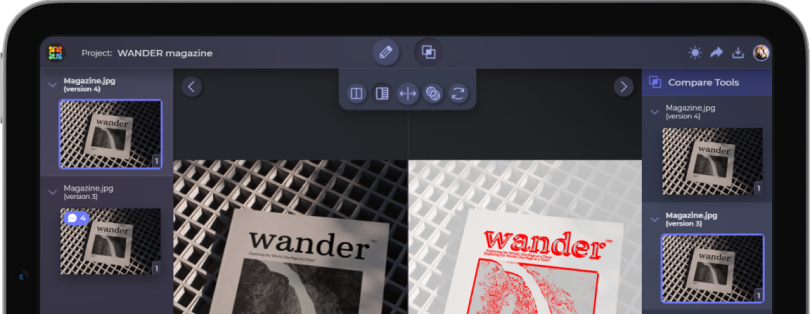
Approval Studio is the tool made to make sure every part of your design team work works properly
Start a Free TrialGoal misalignment
Successful teamwork depends on how aligned your goals are with each other and with the main purpose of any project. You may ask yourself, isn’t it too selfish to want a benefit in a teamwork environment? While it might seem that pursuing a personal benefit in a common goal is something that will stop each individual from actually working towards that goal, it’s not.
The very foundation of great work is motivation. There are many ways to motivate people, but the best one has always been to offer personal incentive. The simplest form of personal incentive is salary: each person in a team knows that if they finish the project, they will each get paid. Or, for example, it’s a team of individuals who care about the cause. Then, each team member will do what they think is best for it.

However, if your team doesn’t know the goal, or their personal gain is not aligned with the project in any way, their motivation will not disappear quickly. If, in your custom POD design startup, you want to spread your designs into the world, and your partner wants to make money, it won’t work. And none of you is wrong; you just want different things, and that is critical in teamwork.
Lack of trust
If the trust between teammates has been breached once and is unresolved, it’s likely to happen again and ultimately ruin the teamwork in the long run. Trust can be many things: you’re not afraid to mess up, you feel relaxed around team members, or you trust your coworkers to do their job on time.
Trust breaches happen all the time. And it’s okay, life can happen. One missed deadline or inappropriate comment will not change much by itself. However, if you don’t go out of your way to work through that breach, it can turn into a disaster. When trust has been betrayed a few times, the team starts to form a set of emotions to associate with the person. It can be wariness, anxiety, disdain, or even resentment. When not resolved (whether by communicating or removing the source), it can result in a significant drop in team efficiency and overall team culture.

Improper communication
Improper communication is the key to creating all team collaboration issues, as well as a way to resolve them. This is the most important reason why team collaboration fails, so I saved it for dessert.
Improper communication ruins teamwork because it creates uncertainty, assumptions, and emotional buildup. When a design team doesn’t talk clearly, consistently, or respectfully, the work becomes a literal puzzle where everyone has a different number of pieces. You might think someone is ignoring your message, while they are building up the courage to respond to what they perceive as criticism. You assume a teammate understands the urgency, while for them, it’s just another task. Then, complications happen, and no one trusts anyone anymore when the project misses its deadline.
Design work depends on clarity. If you don’t understand the problem correctly, you won’t solve it correctly. The same applies to teammates: if you don’t understand each other, you won’t build anything meaningful together. One moment, you think that it’s okay, they’ll figure it out. And the next one, you have to deal with duplicated tasks, missing information, bad handoffs, slow reviews, emotional friction, and ultimately, frustration. And frustrated designers don’t create good work, no matter how talented they are.
At some point, if the communication pattern doesn’t change, people stop trying. They avoid meetings, shorten responses, and lose motivation. And this is the moment when teamwork stops being “teamwork” and becomes “a group of individuals doing their own thing under the same Slack workspace.”

How to improve communication in your team
Now that we’ve established how damaging poor communication can be, let’s talk about what can actually fix it. The good news is that communication is a skill. Each person on the team should learn, practice, and improve it all the time. And you don’t even need a psychologist or a corporate retreat for that. All you need is consistency and intention.
Here are five ways to improve communication in your design team:
1. Clarify the purpose before you speak
Most communication issues start because someone doesn’t know why they’re saying something. Before you send a message, ask yourself:
– Am I giving information, asking for something, or sharing feedback?
– What outcome do I need from this message?
– Is the other person equipped to act on what I’m saying?
2. Stop assuming and start verifying
Nothing destroys collaboration faster than assumptions. “I thought you were doing it.” “I assumed this was the final version.” “I figured you knew.” Instead, adopt a simple habit: verify.
This isn’t micromanaging. However, it does ensure deadlines are met.
– “Can you confirm that you’ll handle this by Thursday?”
– “Just to check, is this the latest file?”
3. Document even the smallest decisions
Design teams tend to rely on memory and vibe. That works… until it doesn’t. Every decision should be recorded somewhere accessible. Humans have an annoying tendency to forget, so make sure every step of the way is documented, even as a small message.
– “Pushed deadline till Friday”
– “Passed the task over to Max”
– “Nothing new found on NOV-24, will keep on looking tomorrow”
4. Give feedback the way you’d like to receive it
Design feedback is tricky. It’s personal, but it shouldn’t feel like that. Decisions we make about design can depend on our mood and how many hours of sleep we got today. Hence, it’s crucial to be as gentle and detail-centered as possible.
Bad feedback sounds like:
–“Make it pop.”
–“Something is off.”
–“It’s not giving.”
Good feedback, on the other hand, is focused on analysis and offering solutions: “The hierarchy feels unclear. Maybe increase the contrast between these elements.”
5. Be human first
Teams often think communication means more messages, more meetings, more structured frameworks. But sometimes, all you need is honesty and giving a person space to be vulnerable. At the end of the day, that’s what we long for.
– “Hey, I’m confused, can you explain this part again?”
– “I’m overwhelmed; can we reorganize priorities?”
– “I understand the stakes, but we have to be realistic.”
Conclusion
Team collaboration is not some mystical talent that only certain groups are born with. It’s a system, and like any system, it depends on how well its parts connect. Goal misalignment, lack of trust, and improper communication are not flaws of personality—they are symptoms of unclear processes, unmet needs, and unspoken expectations.
Design thrives in environments where people feel heard, supported, and aligned. When communication works, everything else—from brainstorming to execution—feels lighter. When it doesn’t, even the simplest tasks feel like swimming through cement.
If we want stronger, healthier, more creative design teams, we don’t need new tools or stricter rules. We need to talk to each other. Clearly, honestly, and consistently. Because at the end of the day, collaboration is not about working together. It’s about understanding each other well enough that working together stops feeling like work.