TEAM SOLUTIONS
 WORKFLOW SOLUTIONS



 REVIEW TOOL
 PROJECT MANAGEMENT
 TOOLS & INTEGRATIONS
 CLIENT INTERVIEWS




Post is also avalible in:


However, creative collaboration is not just about working in the same room or sharing files. In fact, it’s a structured way of combining different skills, perspectives, and responsibilities to produce output that’s better than any one person could produce alone.
For creative teams and agencies, this process is at the heart of everything they do. And when it works well, it shows in faster turnaround times, cleaner deliverables, and, consequently, happier clients.
Why Creative Collaboration Matters
Creative collaboration has a real, measurable impact on how teams operate and what they actually deliver.
When people work independently, withholding information and limiting collaboration with others (in silos), good ideas usually stay stuck. For instance, a designer doesn’t know the client has changed direction, or a copywriter rewrites a headline that’s already been approved. As a result, you end up with wasted hours, missed deadlines, and work that has to go through yet another cycle of creative approval.
Effective creative collaboration was designed to avoid all of that. It creates shared visibility across the team, keeps everyone working from the same brief, and turns the review and approval process into something that actually moves forward rather than spinning in circles.
For agencies and studios, collaboration is also a competitive advantage because clients notice when a team is coordinated. They feel it in how clearly they’re communicated with, how quickly their feedback gets addressed, and how smooth the final delivery feels.
To put it more concretely, here’s how creative collaboration compares to working in silos across the things that matter most:
Ultimately, the shift from siloed work to structured collaboration is about having a clear record of what was decided, what changed, and who signed off on it. And that matters more than most teams realize, until something goes wrong.

The Key Elements of Effective Creative Collaboration
Not all collaboration works equally well. The teams that do it successfully tend to have a few things in common. And now we’ll discuss what those things are.
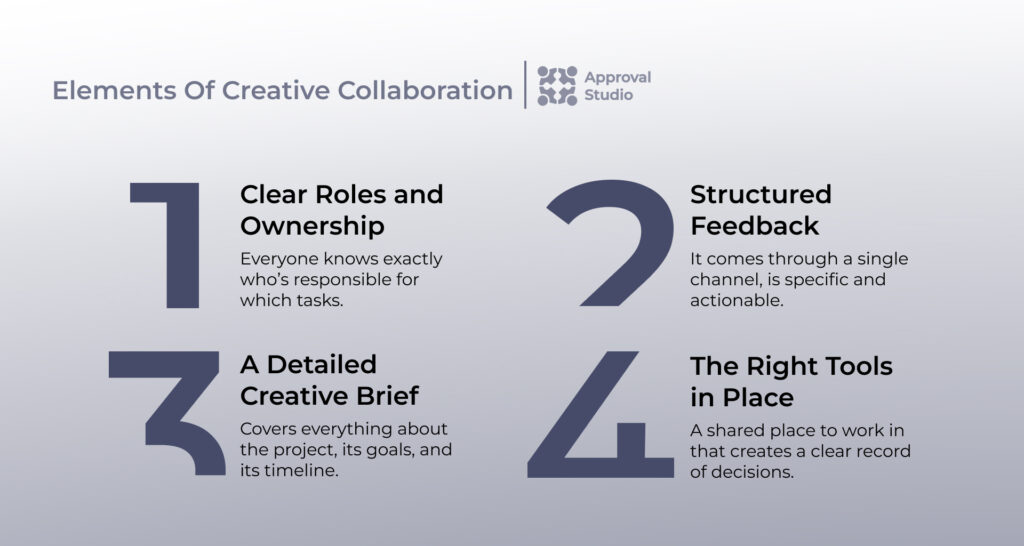
Clear Roles and Ownership
For clarity, every project needs someone who owns each part. It’s crucial to establish who’s responsible for the first draft, who has final say on design, and who manages external client communication. When these questions don’t have clear answers, the whole creative workflow stutters, and blame gets passed around.
Even though defining roles at the start of a project may seem like red tape, it’s actually what lets a team move fast without stepping on each other.
Structured Feedback Loops
Unorganized feedback is another pain point that slows down your work process. When it comes in late and from too many people at once, it contradicts itself and is often too vague to act on.
Meanwhile, structured feedback happens at defined stages, comes through a single channel, and is specific enough to be actionable. Apart from making life easier for the creative team, it also produces better outcomes because clients and stakeholders are asked to think clearly about what they actually want before hitting send.
A Shared Creative Brief
A good creative brief is the foundation of any collaborative creative project. Essentially, it aligns everyone on the goal, the audience, and the constraints before a single pixel is placed. This document is your holy grail that routes the whole work process through a preliminary approved plan. If anyone has questions about the project, its goals, or its timeline, the creative brief is the reference.
Without a brief, instead of collaborating, your team is just hoping you all end up in the same place. And while hope dies last, having a structured plan is a way more effective strategy.
The Right Tools in Place
Since people mainly collaborate through tools, their quality directly impacts the quality of collaboration. For example, if feedback is scattered across email threads, Slack messages, and five different platforms, even a well-organized team will struggle. That’s why investing in the right design collaboration tools is so important. The right software centralizes communication, creates a clear record of decisions, and gives everyone, including the client, a shared place to work from.
Common Challenges in Creative Collaboration
If we’re being honest, even the most polished creative collaboration process has its bottlenecks. Teams may run into the same friction points over and over. Here are the most common ones.

Version Confusion
“Is this the final version?” is one of the most dreaded questions in any creative workflow. When files are shared as attachments, renamed inconsistently, or stored across multiple platforms, it’s nearly impossible to know what the current version actually is. Teams end up working on outdated files, which means rework and delays.
Misaligned Expectations Between Clients and Creatives
If it’s not established preliminarily, clients often get confused about how to give feedback. Meanwhile, creatives often fail to meet clients’ expectations due to vague requirements and personal vision. The gap between “I’ll know it when I see it” and “we need a revision brief by Thursday” is where most project stress comes from.
Slow Approval Cycles
If you’re waiting for sign-off for too long, it damages overall productivity. And if approvals require chasing, following up, and translating feedback from informal conversations into actual action items, the pace of a project slows to a crawl. From personal experience, I admit this is especially painful at the end of a project, when everyone is already tired, and timelines are already tight.
How Creative Collaboration Works in Practice
So, what does a well-run creative collaboration actually look like from start to finish? Here’s a typical workflow broken down into stages.
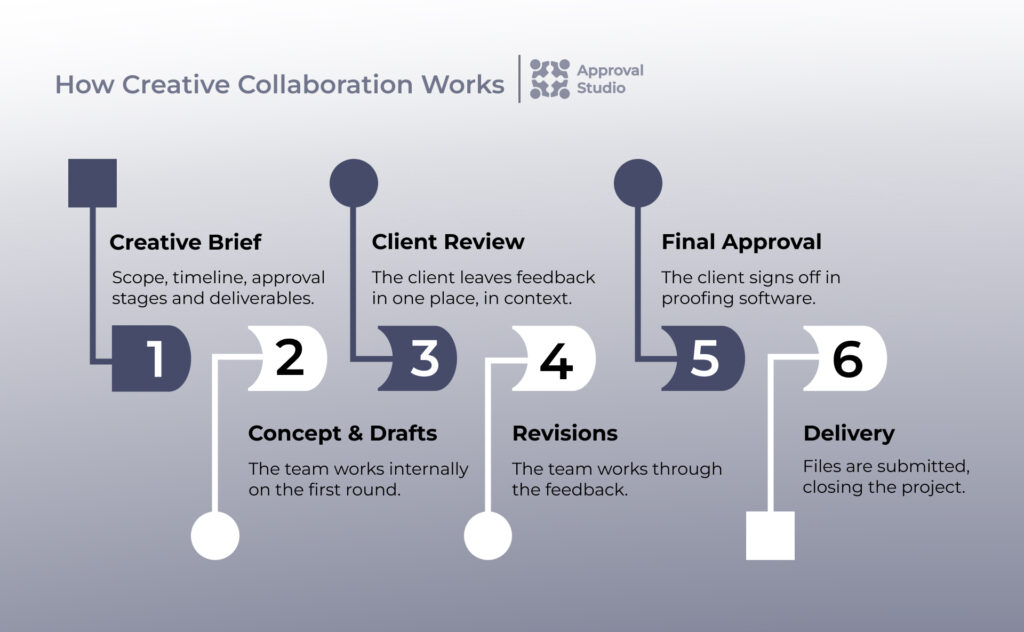
1. Brief and kickoff. The project starts with a shared brief agreed on by both the creative team and the client. Scope, timeline, deliverables, and approval stages are all defined before any work begins.
2. Initial concept and drafts. The team works internally on the first round of creative. This is where design, copy, and strategy come together. Internal review happens before anything goes to the client.
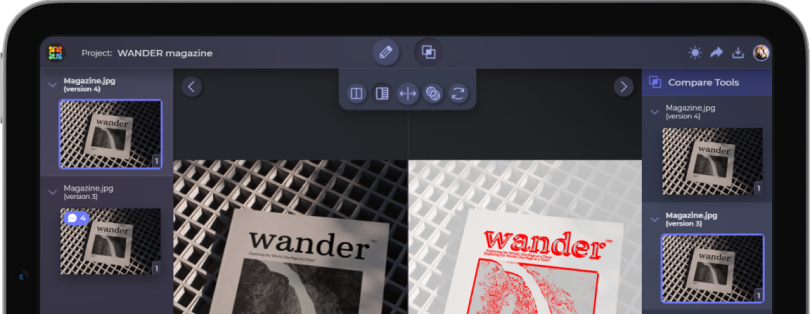
3. Client review. The draft is shared with the client through a centralized system, not an email attachment. The client leaves feedback in one place, in context, against the specific elements they’re commenting on. Using review and approval software at this stage removes the usual back-and-forth and makes it clear exactly what needs to change.
4. Revisions. The team works through the feedback. Because there’s a clear record of what was requested and what was changed, no one is second-guessing whether a comment was actually addressed.
5. Final approval. The client signs off. With client proofing software, this is a formal action, with a timestamp, a name, and a record, rather than a “looks good!” reply that might be disputed weeks later.
6. Delivery. Files are handed over in the agreed formats, and the project is closed with a full record of everything that was reviewed, revised, and approved.
Who Uses Creative Collaboration?
Generally speaking, creative collaboration isn’t limited to one type of team or industry. It applies to anyone who produces creative work and routes it through other people before it goes live or goes to print. That said, some teams rely on it more heavily than others.
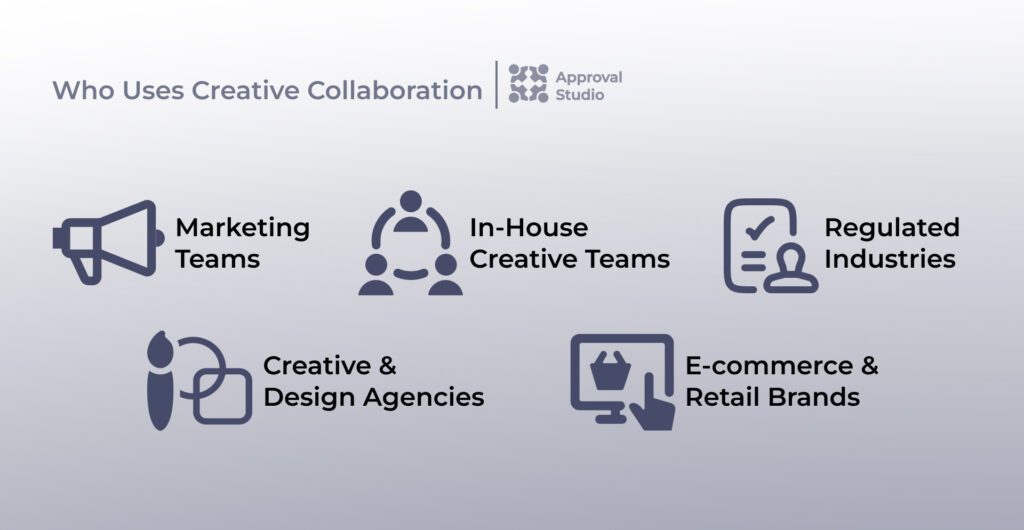
Marketing Teams
Marketing teams use creative collaboration to manage marketing campaign approval cycles, social media assets, email templates, approve landing pages, and digital ads. Because multiple stakeholders often need to sign off, including legal, brand, leadership, and media buyers, a structured process is what makes it possible to hit launch dates consistently rather than at the last minute.
Creative and Design Agencies
For agencies, creative collaboration is the core of every client engagement. It covers everything from initial concept presentations to final artwork approval. Structured collaboration makes the feedback process more professional, reduces revision rounds, and gives clients a transparent experience that builds long-term trust in the agency.
In-House Creative Teams
In-house teams at larger companies often work across multiple departments at once, serving marketing, product, HR, and sales simultaneously. Without a clear collaboration process, requests pile up, priorities clash, and the team becomes a bottleneck rather than an asset.
E-Commerce and Retail Brands
Retail businesses producing product photography, packaging, and promotional materials at volume use structured creative collaboration to make sure everything passes compliance and brand review before going to print. Because catching a label error after production is significantly more expensive than catching it during the proof stage.
Regulated Industries
Industries like pharma, financial services, legal services, and those who work with packaging artwork approval rely on structured creative collaboration specifically for the approval record it creates. Every piece of outgoing communication needs a documented review trail, and a proper collaboration process provides that automatically.

Creative Collaboration for Client-Facing Teams
The truth is that for agencies, studios, and freelancers, creative collaboration isn’t just an internal process. For them, it directly impacts the relationship with the client.
And such a dynamic creates a different set of challenges. For once, clients aren’t always familiar with how creative work gets made. Hence, they don’t always know how to give actionable feedback. Moreover, clients have their own internal approval chains that can hold up a project in ways you can’t control from the outside.
However, a structured approach to client collaboration addresses all of this. It sets clear expectations from the start, gives clients a dedicated space through a client collaboration tool where they can see work in progress, leave feedback, and track where things stand. And it gives the creative team a single source of truth instead of a scattered inbox.
In fact, the teams that invest in client collaboration software tend to win more repeat business. Not necessarily because their work is better, but because the experience of working with them is.
Creative Collaboration Best Practices
Although we’ve already discussed quite a lot about creative collaboration, knowing the process is one thing. But running it well is another. What I’m implying is that there are habits that separate teams that collaborate smoothly from those who keep hitting the same friction points, project after project. Here’s a list of the 7 best creative collaboration practices.
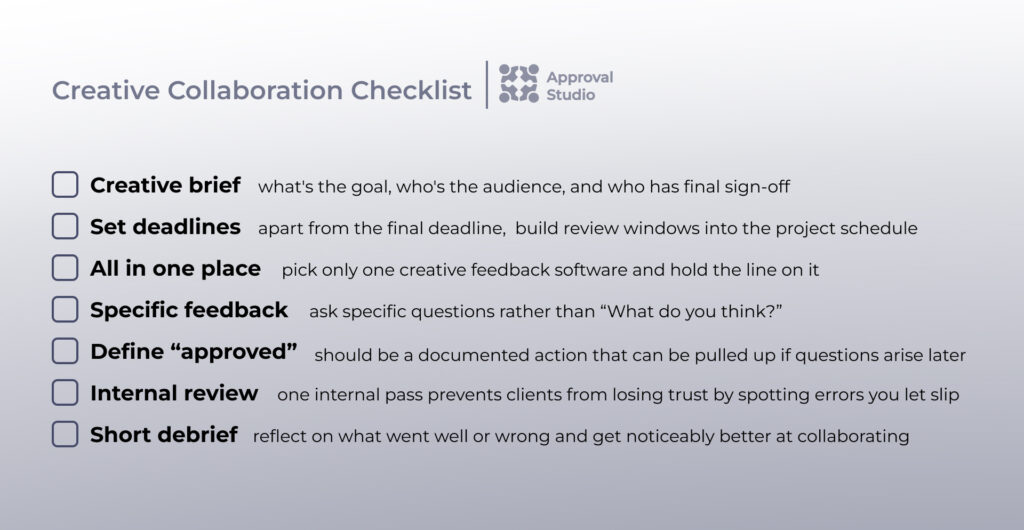
Always start with a brief
The temptation to skip the brief on a quick job is what can turn it into a long, rocky road trip. Moreover, a brief doesn’t need to be long. All it needs to do is answer four questions: what’s the goal, who’s the audience, what does success look like, and who has final sign-off. This is how five minutes at the start saves hours later.
Set both feedback and delivery deadlines
Most timelines account for how long it takes to create the work. Far fewer account for how long it takes to get feedback on it. So, in order to see the full picture, build review windows into the project schedule from day one, and communicate them to the client as clearly as you communicate the delivery date.
Keep feedback in one place
This is the rule that’s easiest to agree on and hardest to enforce. When feedback arrives through multiple channels, something will inevitably get missed. Pick one creative feedback software and hold the line on it. Make sure that anything that comes in through the wrong channel gets redirected back to the right one.
Make feedback specific by default
Vague feedback isn’t usually the client’s fault, but a sign that they weren’t given the right prompt. Instead of asking “What do you think?”, ask whether the headline matches the tone agreed on in the brief, or add a design approval checklist. Specific questions produce specific answers, and specific answers lead to fewer revision rounds.
Define what “approved” actually means
A verbal “looks good” in a meeting isn’t an approval, and neither is a thumbs-up in chat. An approval should be a documented action with a name, a timestamp, and a record that can be pulled up if questions arise later. This matters most when something goes wrong, which is exactly when no one wants to be searching through old email threads.
Internal review before anything goes to the client
Everything that goes to a client should pass through at least one internal review first. Not to perfect it, but to catch the obvious things: a wrong logo version, a placeholder that was never replaced, or a headline that doesn’t match the brief. Clients lose confidence when they spot errors the team should have caught, and one internal pass is usually all it takes to prevent that.
Close the loop after every project
A short debrief at the end of a project compounds over time. Teams that reflect on what went well and where things slowed down get noticeably better at collaborating, not because they’re more talented, but because they keep learning from their own process.
Creative Collaboration vs. Project Management
Some teams that already use a project management tool like Asana or Monday.com might wonder whether they actually need anything else. It’s a fair question, so it’s worth drawing a clear line between the two.
Project management tools are built for tracking tasks, milestones, timelines, and team workloads. They answer questions like: what’s due this week, who’s responsible, and is the project on track? Those are genuinely useful things to know.
However, they’re not built to review creative assets. They can’t annotate a specific region of an image, pin a comment to a frame in a video, compare two versions of a file visually, or send a proof through a sequential approval chain where legal signs off before the CMO sees it. Those are the things that happen inside a client collaboration tool, not inside a task board.
So the two categories aren’t really competing with each other. Your project management tool handles the overall project timeline. Meanwhile, your creative collaboration handles the asset review cycles that happen within it. In fact, many teams run both in parallel, using integrations to connect them so that an approved proof automatically closes the relevant task without anyone doing it manually.
If your team is trying to manage creative review inside a project management tool, you’re probably not getting the most out of either one.
Final Words
Creative collaboration, at its core, is about closing the gap between what a team intends to create and what a client actually receives. That gap is mostly filled with miscommunication, feedback that wasn’t captured, approvals that weren’t formalized, and versions that weren’t tracked.
The good news is that most of these problems are solvable. A clear process, defined roles, and the right tools go a long way toward making collaboration feel less like a series of near-misses and more like a system that actually works.
So if your design review and approval process is where things tend to break down, that’s usually the highest-leverage place to start.