TEAM SOLUTIONS
 WORKFLOW SOLUTIONS


 REVIEW TOOL
 PROJECT MANAGEMENT
 TOOLS & INTEGRATIONS
 CLIENT INTERVIEWS




Post is also avalible in:


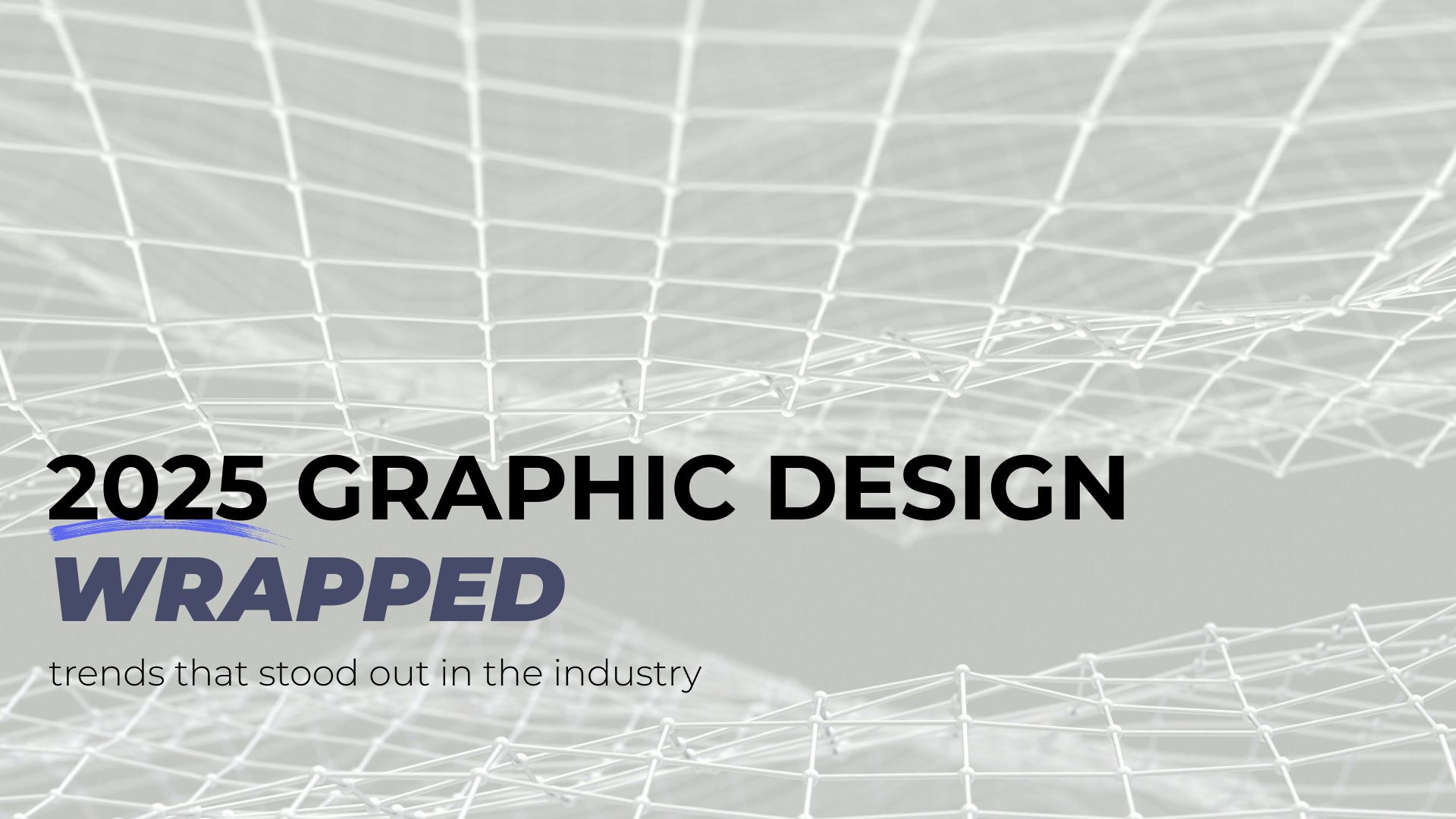
Here we meet again, the last month of the year. You know, in the retrospective, I’d say 2025 was weird. And not like bad weird, just… a lot to swallow. Graphic designers seem to have had everything at their disposal, give or take. This time, we’ve had both contrasting styles and the existential dread of the cunning AI taking over and leaving us jobless. All this combined with what’s going on around the world? Oh, dear… But I digress.
How about we take some rest from reality and talk shop, wrapping up the “graphic design 2025”?
AI-Generated Design
Oh boy, the conversations around this matter… Let’s just say that as of the end of 2025, AI still hasn’t succeeded in replacing designers. However, it has considerably pervaded the industry: it seems as if everybody has added this or that AI-powered feature to their software (we, too). And it matters to mention that in considerate use, AI can serve as a great assistant in your workflow. Just don’t expect it to do everything for you.
The numbers back this up. Adobe’s State of Creativity Report found that nearly two-thirds of designers now integrate AI into multiple stages of their work process. What is it they use?
Throughout the year, Midjourney and similar platforms have evolved from novelty into daily parts of the creative process. AI-based tools can now generate a balanced color palette for you, or visualize a draft of your concept, and do lots of other little things that save you time and nerves.
These also include:
- Design assistant bots that scan your work and offer feedback for refinement;
- Website layout creation tools to save you time sketching them.
- Motion graphic generators that make animations from your text prompts;
- Mock-up generators that transmit your design to a custom mock-up.
All in all, technology continues to evolve, and we can expect to see more of it in graphic design in 2026. Though the cases of people not being able to tell an AI-generated media from a real one do sound rather alarming.
Digital Scrapbooking and Y2K
While it’s true that AI is here and thriving, no one said people won’t oppose it. That’s why such design elements as collaged textures, hand-drawn elements, and intentionally imperfect forms and composition appealed to us so much this year. The rough edges and visible human touch behind them served more as a statement rather than just aesthetics.
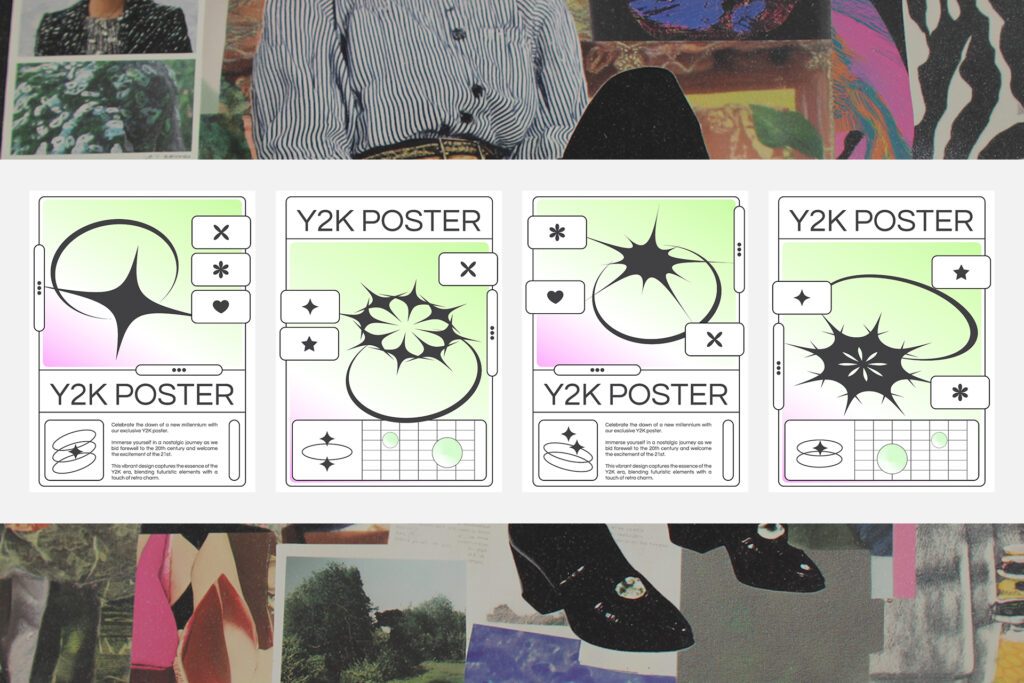
What’s more, this trend most likely stems from the roaring Y2K maximalism that’s completely pervaded 2025. Obviously, brands are seeking ways to target Gen Z. And nothing strikes the audience better than nostalgia with a vintage taste to it. Similarly, it brought back that vibe of a pre-smartphone era and the early Internet optimism, when technology still felt fresh and exciting.
Consequently, you have it: electric blues, hot pinks, and lime greens, combined with bold gradients and, of course, chrome (even though Pantone does not seem to agree with that). Throughout designs, you’ll come across bubbly forms, pixels, and star-shaped motifs. Especially if the target audience is the youth.
Not sure you’re aiming the right audience?

Get quick feedback and advice via Approval Studio’s external review. With no need to fiddle with sign-ins!
Start a Free TrialPop-Futurism
As well as the past is a place of comfort, the future is a place of hope. We certainly got sick of dystopia and decided to put on a sugar-coated lens. Because what if the future didn’t actually suck? And here you have it – pop-futurism, which is essentially based on Y3K and refined with the Korean pop culture and futuristic concepts.

To spot pop-futurism in the wilds of graphic design, look for pastel tones, liquid metallic textures, skeuomorphism, and whimsy 3D typography. Though sci-fi may sound serious, this trend mixes the technological part with bubblegum and avant-garde K-fashion. It’s also worth noting that generative AI played a big role in creating futuristic settings and cyborg-esque elements.
In 2025, everybody seems to try and inject some joy into their visual identity, from Kim’s SKIMS to Tesla Motors. And pop-futurism served as an incredible opportunity to position your brand as both innovative and fun.
Bold Minimalism
Perhaps, minimalism will always be relevant as the “less is more” approach has become a fundamental principle. However, who said it can’t morph and obtain new twists to it?
The new wave of minimalism strayed away from the sleek Scandinavian look we’ve all known and has grown some teeth. Though the elements of design are few, it’s now supported by vibrant splashes of color and emphasized with bold, oversized typography. The style has evolved into something bigger, punchier, and more attention-grabbing. Instead of being quiet and airy, it now uses reduction to amplify certain elements. Bold minimalism has united simplicity and impact.
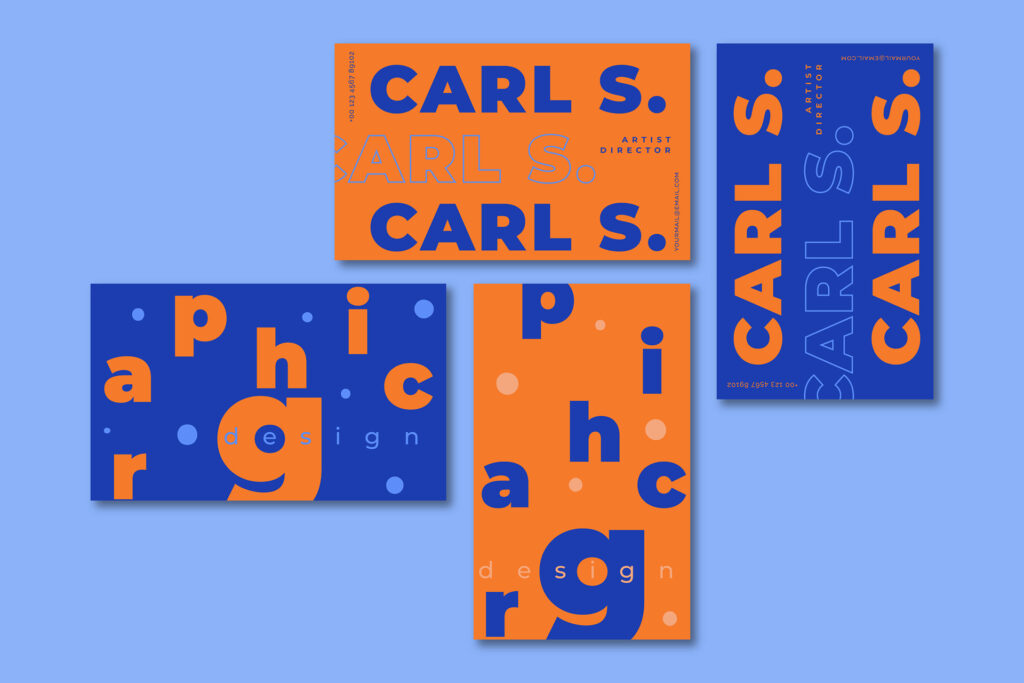
Plenty of negative space creates emphasis and builds tension. And designers put huge typography as the main visual factor rather than graphics or illustrations. The picture remains modern and sleek-looking while still able to catch attention. The effect it creates causes instant recognition in the cluttered feeds. And fast impact is what digital advertising needs most.
3D, Immersive, and Hybrid
If there’s one thing 2025 proved, it’s that designers finally stopped treating 3D as some magic and just… adopted it. Quietly, casually, like it’s been part of everyone’s toolbox all along. And honestly? It kind of has.
Interestingly, the focus shifted from aggressively photorealistic objects to the overall atmosphere. Soft lighting, tactile textures, and the play of shapes in space is what began to really matter. Thanks to faster rendering, browser-native 3D support, and AI that can generate a base model in seconds, designers have been blending 2D and 3D into seamless compositions. This led to flat shapes paired with floating 3D objects, or 2D logos sitting in a three-dimensional scene. And various textures combined with cinematic lightning created tactile surfaces that make people want to touch the screen. Liquid metals and glossy orbs got spotted here as well.
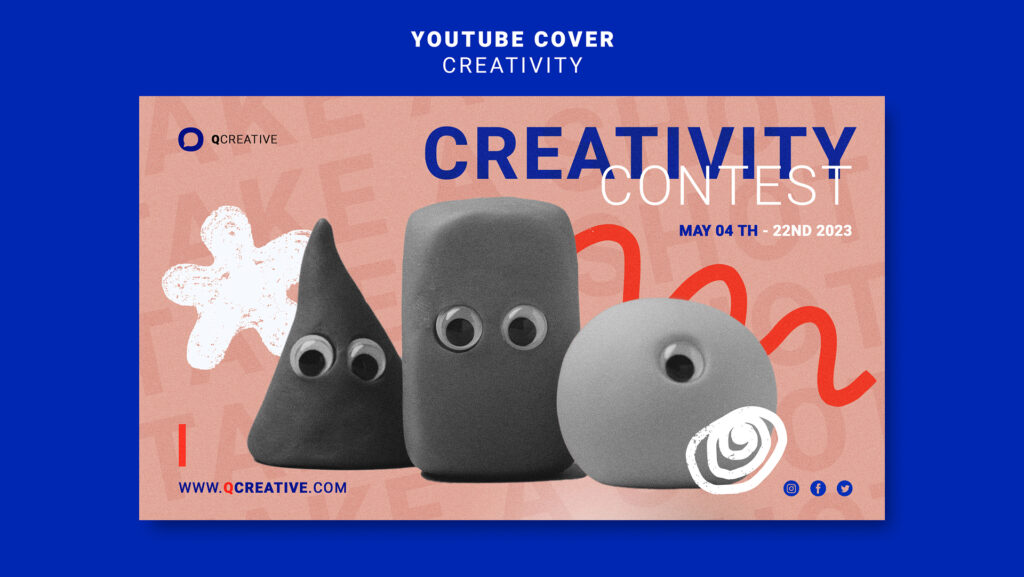
As of now, 3D is no longer the future but is the present. It just feels incredibly native to the visual culture of 2025, where AR, VR, and mixed reality environments are slowly but steadily claiming space.
Experimental Typography
So far, we’ve mentioned typography quite a lot of times in this article. And that’s for a good reason. Recently, type stopped being static decoration and became a dynamic part of the experience.
Now, landing pages feature kinetic type reacting to scroll. Brand identities contain fluid letterforms shifting between weights. It seems like motion designers in 2025 had the time of their lives. Instead of typography being a vessel for text, it became somewhat of a main character – bold, performative, expressive. High-contrast typography also dominated. Big, bold display faces with dramatic thick-to-thin strokes became the go-to for making statements. Editorial design especially loved this, for nothing says “read me” like a massive serif.
This trend dominated posters, fashion campaigns, album art, social media visuals, and the homepages of websites everywhere. The result is a design landscape where words a rather experienced than read.
Conclusion
And there you have it – the 2025 graphic design trends wrapped. If anything, 2025 showed that graphic design is still very much alive and kicking. And not despite AI, trends, or rapid shifts in visual culture, but because of how we adapt to them. Designers still crave human touch, authenticity, and the freedom to make things messy on purpose.
Looking ahead to 2026 graphic design? Who knows. Maybe we’ll all go minimalistic again. Maybe AI will actually get scary. However it goes, the best work comes from designers willing to experiment, break rules, and occasionally make something weird just to see what happens.
Keep making cool work. See you in 2026.